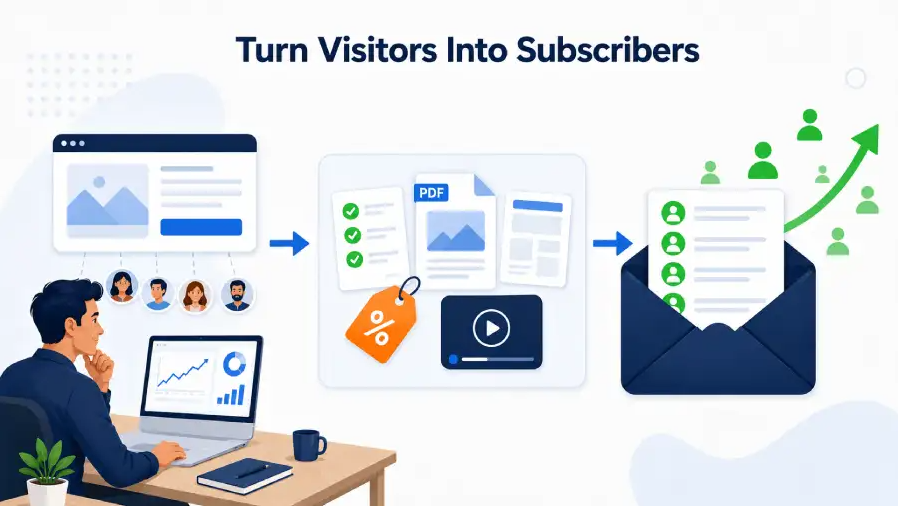
Lead Magnets Explained: How Online Businesses Turn Visitors Into Subscribers
A website visitor is not automatically a future customer.
They may read an article, browse a product page, or click an ad—and leave without taking action. This is why many online businesses use lead magnets: useful free resources offered in exchange for an email address.
A good lead magnet gives visitors a clear reason to stay connected. Instead of asking, “Join our newsletter,” a business offers something specific that solves a small but relevant problem.
For an affiliate marketer, that may be a campaign checklist. For a software business, it may be a free template. For an e-commerce store, it may be a discount on a first order.
This guide explains what lead magnets are, how they work, and how to create one that helps turn website visitors into subscribers.
What Is a Lead Magnet?
A lead magnet is a free and useful resource that a business gives to a potential customer in exchange for contact information—usually an email address.
The value does not need to be huge. In fact, the best lead magnets often solve one small, urgent problem quickly.
Examples include:
- A checklist
- A PDF guide
- A short email course
- A template
- A discount code
- A webinar
- A free tool or calculator
- A product comparison sheet
- A quiz with personalized results
The main purpose is not just to collect email addresses. It is to start a relationship with people who are interested in a specific topic, need, or product.
Why Lead Magnets Work
People are careful about sharing their email addresses. They know that an inbox can quickly become crowded with unwanted promotional messages.
A lead magnet gives visitors a fair exchange: they receive something useful now, while the business earns permission to follow up later.
This approach works because it can:
- Give visitors immediate value
- Help businesses understand what their audience wants
- Build trust before asking for a sale
- Create a direct communication channel
- Support long-term email marketing
The most effective lead magnets are closely connected to what the business eventually sells. A free resource should attract the same type of person who may later benefit from the paid product or service.
7 Lead Magnet Ideas for Online Businesses
1. Checklists
Checklists are simple, practical, and easy to use. They work well for audiences that want a clear step-by-step process.
Examples:
- A new-business launch checklist
- An affiliate marketing funnel checklist
- A website SEO checklist
- A product photography checklist for online stores
A checklist is effective because it reduces confusion. It gives the reader a quick roadmap rather than a long theory lesson.
2. Templates
Templates save people time, which makes them highly valuable.
A business can offer:
- Email templates
- Social-media content calendars
- Budget spreadsheets
- Landing-page wireframes
- Outreach-message templates
For example, a new affiliate marketer may find a “Five-Email Welcome Sequence Template” more useful than a general article about email marketing.
3. Short Guides
A guide can explain one topic in more detail than a blog post. It should be focused, readable, and designed to help beginners take action.
Good guide topics include:
- How to choose a niche for an online business
- How to create a landing page for a free offer
- How to plan a first email campaign
- How to prepare an online course launch
Avoid making the guide too broad. “The Complete Guide to Online Business” is less useful than “How to Create Your First Lead Magnet in One Weekend.”
4. Discounts and First-Order Offers
Discounts are common for e-commerce brands because they give visitors an immediate reason to subscribe.
For example:
- 10% off a first order
- Free shipping on a first purchase
- Early access to a new collection
- A limited-time bundle offer
This type of lead magnet is most effective when the visitor is already interested in the product. It may not create the same long-term education value as a guide, but it can help turn product-page visitors into email subscribers.
5. Free Webinars or Training
Webinars are valuable when a topic needs explanation, demonstration, or trust-building.
A consultant might offer free training on improving business systems. A course creator may teach one useful lesson before presenting a full program. An affiliate marketer may share a beginner workshop on choosing an offer and building a simple funnel.
A webinar can create stronger engagement because people invest time, not just an email address.
6. Quizzes and Calculators
Interactive tools can make lead generation feel more personalized.
Examples include:
- “Which marketing channel fits your business?” quiz
- Website conversion calculator
- Savings calculator
- Product finder quiz
Visitors often share their email address to receive a personalized result, recommendation, or follow-up resource.
7. Free Email Courses
An email course delivers a short lesson over several days. This is useful because it trains subscribers to open your emails and expect value from them.
For example:
- A five-day email-list-building course
- A seven-day beginner affiliate marketing challenge
- A short course on launching an online store
- A three-day guide to writing better marketing emails
The first lesson should arrive immediately after sign-up. Each email should be useful on its own while naturally leading toward the next step.
How to Choose the Right Lead Magnet
Before creating anything, ask these questions:
- What problem does my ideal customer want solved now?
- Can I provide a quick, clear result?
- Does this resource connect to my product or service?
- Would the right audience genuinely want it?
- Can I explain its value in one sentence?
For example, a business selling email-based traffic to affiliate marketers could offer a resource such as “The Affiliate Funnel Readiness Checklist.” It would attract people who need traffic but first need to confirm that their landing page, lead magnet, and follow-up emails are ready.
This is much stronger than offering an unrelated generic ebook.
Match the Lead Magnet to the Traffic Source
A lead magnet must fit the audience that sees it.
Someone finding your article through Google may want a detailed guide. Someone scrolling on social media may prefer a short checklist or quiz. Someone arriving from an email promotion may respond best to a focused free training or downloadable resource.
For marketers testing email-based traffic for a digital offer, a clear opt-in page and relevant lead magnet are essential. Services such as solo ads for affiliate marketing can help bring targeted visitors to a funnel, but the offer must give those visitors a meaningful reason to subscribe.
Do not send paid traffic to a vague homepage and expect strong results. Send it to a landing page that matches the message used in the promotion.
Create a Simple Lead Magnet Landing Page
Your landing page does not need complicated design. It needs clarity.
Include these elements:
- A headline that explains the benefit
- A short description of what the visitor will receive
- Three to five bullet points showing the value
- A simple form asking only for necessary information
- One clear call to action
- A privacy note explaining that the subscriber can unsubscribe
For example:
Headline: Get the Free Affiliate Funnel Checklist
Description: Review your landing page, lead magnet, tracking, and email sequence before you spend money on traffic.
Button: Send Me the Checklist
Keep the page focused. Too many links, products, and calls to action can distract visitors from signing up.
Follow Up After the Sign-Up
A lead magnet is only the beginning.
Once someone subscribes, send the promised resource immediately. Then create a short welcome sequence that continues helping them.
A simple sequence may include:
- Deliver the lead magnet
- Share one useful tip related to the resource
- Explain a common mistake and how to avoid it
- Introduce a relevant product, service, or next step
- Invite the subscriber to reply with a question
The goal is to build trust through useful communication—not to pressure people into an immediate purchase.
Measure What Happens Next
Track more than total subscribers. Useful metrics include:
- Landing-page conversion rate
- Cost per lead
- Email open rate
- Email click-through rate
- Unsubscribe rate
- Sales or enquiries from subscribers
Tracking shows whether your lead magnet is attracting the right people. A resource that produces fewer subscribers but more engaged readers may be more valuable than one that gets many low-quality sign-ups.
Final Thoughts
Lead magnets help online businesses turn anonymous visitors into people they can serve over time.
The best lead magnet is specific, useful, and closely connected to the business offer. Start with one small problem your audience wants solved. Create a simple resource, build a clear landing page, and follow up with helpful emails.
When visitors receive real value first, they are more likely to become engaged subscribers—and eventually, informed customers.
Frequently Asked Questions
What is a lead magnet?
A lead magnet is a free, useful resource offered in exchange for contact information, usually an email address. Common examples include checklists, templates, discount codes, webinars, guides, and email courses.
What makes a good lead magnet?
A good lead magnet solves a specific problem quickly and is relevant to the product or service a business offers. It should be easy to understand, useful to the right audience, and clear enough to explain in one sentence.
Do lead magnets help grow an email list?
Yes. Lead magnets give visitors a clear reason to subscribe instead of simply asking them to join a newsletter. Their success depends on the value of the resource, the landing page, the traffic quality, and the follow-up email sequence.
What should happen after someone downloads a lead magnet?
Send the promised resource immediately, then use a short welcome email sequence to provide useful tips, build trust, and introduce a relevant next step, product, or service.